Best Survival Tips for 99 Nights in the Forest: The Ultimate 2026 Guide
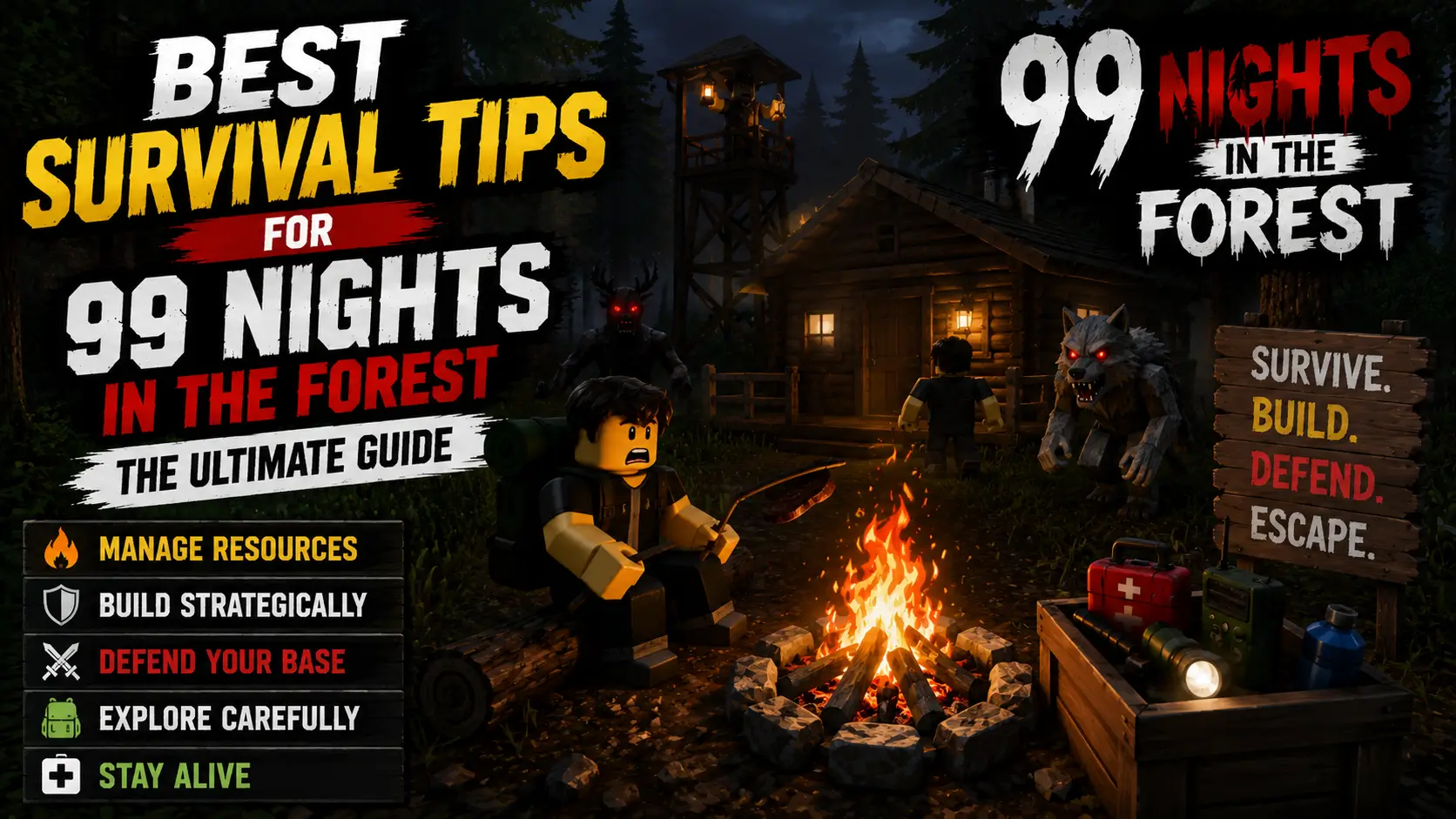
You’re on Night 47. Wood is running low, the temperature is dropping, and something is moving in the trees behind you. Welcome to 99 Nights in the Forest one of Roblox’s most brutal survival horror experiences. Whether you’re looking for a 99 Nights in the Forest survival guide, wondering how to survive 99 Nights, or need beginner survival tips to get past your first week, this is the only guide you’ll need.
📑 On this page
- Understanding the Core Mechanics
- Best Survival Tips for 99 Nights in the Forest: Resource Management
- Best Survival Tips for 99 Nights in the Forest: Base Building
- Best Survival Tips for 99 Nights in the Forest: Night Survival
- Best Survival Tips for 99 Nights in the Forest: Missing Children Events
- Late-Game Survival: Nights 51-99
- Beginner vs. Advanced: Strategy Comparison
- Solo vs. Multiplayer: Complete Comparison
- Common Mistakes That Kill Players
- Gear & Upgrade Priority
- 99 Nights Survival Checklist
- FAQ: Best Survival Tips for 99 Nights in the Forest
- Final Thoughts
- Explore More Strategies
I’ve spent 200+ hours in this game, died countless times, and learned every hard lesson so you don’t have to. These are the best survival tips for 99 Nights in the Forest no scripts, no cheats, just legitimate strategies that work from Night 1 to Night 99.
Understanding the Core Mechanics
Before diving into tips, understand what kills you:
| Threat | What It Does | Priority Level |
|---|---|---|
| Hunger | Drains health when empty | Critical |
| Cold | Rapid health loss at night | Critical |
| Enemies | Direct damage, can swarm | High |
| Missing Children Events | Time-limited, high risk/reward | High |
| Resource Depletion | Leaves you defenseless | Medium-High |
The game operates on a day-night cycle. Days are for preparation. Nights are for survival. Mess up the balance and you won’t see morning.
Best Survival Tips for 99 Nights in the Forest: Resource Management
1. The Wood Hoarding Rule
Never let wood drop below 50 units. Ever.
Wood fuels your fire, which keeps you warm, which keeps you alive. New players farm just enough for the current night. Smart players farm for the next three nights.
Pro tip: Days 1-10, prioritize birch trees (fastest chop). Days 11+, switch to oak (more wood per tree, better efficiency long-term).
2. Diamond Prioritization
Diamonds are rare. Spend them wrong and you hit a wall around Night 30.
Best early investments:
- Warmth upgrade (Night 5-7) reduces cold damage
- Backpack expansion (Night 10-12) carry more resources
- Tool durability (Night 15+) less time farming, more time surviving
Avoid until late game: Cosmetic items, pet companions, decorative base elements.
3. Food Stockpiling Strategy
Hunger sneaks up on you. By the time you’re starving, it’s too late.
- Days 1-20: Gather berries and mushrooms (easy, renewable)
- Days 21-50: Hunt rabbits and deer (more calories, requires tools)
- Days 51+: Farm crops (sustainable, but setup-intensive)
Critical rule: Always keep 3 days of food in storage. Never eat your emergency stock.
Best Survival Tips for 99 Nights in the Forest: Base Building
4. Location, Location, Location
Your base location determines everything.
Ideal base criteria:
- Near water source (fishing, cooking)
- Near dense forest (wood farming)
- Elevated ground (enemies struggle with slopes)
- Natural choke points (fewer directions to defend)
Avoid: Open fields, deep valleys, areas with multiple enemy spawn points.
5. The Layered Defense System
One wall won’t save you. Build in layers:
| Layer | Purpose | Materials |
|---|---|---|
| Outer wall | Slows enemies, alerts you | Wood (cheap, replaceable) |
| Traps | Damage/kill before they reach you | Stone + wood spikes |
| Inner wall | Last line before base | Reinforced wood or stone |
| Escape tunnel | Emergency exit | Hidden, unmarked |
Night 30+ upgrade: Add fire pits around perimeter. Some enemies fear fire.
6. The “False Base” Decoy
Advanced strategy: Build a small, obvious shelter 50 meters from your real base. Stock it with minimal resources. Enemies often target the visible structure, giving you time to prepare or escape.
Best Survival Tips for 99 Nights in the Forest: Night Survival
7. The Fire Management Protocol
Fire is life. But fire management separates survivors from casualties.
Night 1-20: One central fire, keep it maxed. Night 21-40: Two fires one for warmth, one for cooking/crafting. Night 41+: Three fires minimum. Enemies can extinguish fires; redundancy saves lives.
Critical: Never let fire drop below 50% intensity during night. The cold spike at low fire is devastating.
8. Enemy Pattern Recognition
Each enemy type has predictable behavior:
| Enemy | Behavior | Counter Strategy |
|---|---|---|
| Wanderers | Slow, solo, attracted to light | Kill quietly, avoid drawing more |
| Pack Hunters | Fast, group of 3-5, flanking | Use choke points, fire barriers |
| Brutes | High health, destroys walls | Kite to traps, never melee |
| Night Stalkers | Invisible until close, high damage | Listen for audio cues, use legitimately earned ESP items |
Pro tip: Nights 10, 25, 50, 75, and 99 have wave events. Prepare extra resources 2 nights before.
9. The “Silent Night” Technique
Some nights, not fighting is the best strategy.
- Extinguish non-essential fires
- Crouch-move inside base
- Let enemies pass if possible
- Save resources for unavoidable fights
This works best Nights 15-35 when enemy density increases but your gear isn’t maxed yet.
Best Survival Tips for 99 Nights in the Forest: Missing Children Events
10. Risk vs. Reward Calculation
Missing children events spawn randomly. Saving them gives rare rewards. Failing costs nothing but attempting and dying costs everything.
My rule: Only attempt rescue if:
- Health is above 70%
- Inventory has 2+ healing items
- It’s Daytime or early night (before 2 AM game time)
- You have escape route planned
Never attempt: During wave nights, when low on food, or if base is under attack.
11. The Speed Rescue Method
If you commit, commit fast:
- Pre-craft speed potions (day before)
- Use shortcuts through known safe paths
- Grab child, ignore loot, run back
- Heal only after you’re safe
Loot greed kills more rescuers than enemies do.
Late-Game Survival: Nights 51-99
12. The Sustainability Pivot
Early game: Scavenge everything. Late game: Produce everything.
- Crop farming (wheat, potatoes)
- Animal husbandry (rabbits in pens)
- Tool crafting station (self-sufficient repairs)
- Water collection system (rain barrels)
The forest resources deplete over time. By Night 60, wild berries are gone. By Night 80, hunting is unreliable. Plan accordingly.
13. The Final Nights Protocol (90-99)
These nights are designed to break you. Here’s how to endure:
| Night | Threat | Preparation |
|---|---|---|
| 90-93 | Increased pack hunters | Max traps, double walls |
| 94-96 | Resource scarcity events | 10-day food stockpile |
| 97-98 | Brute + Stalker combos | Fire maze layout, escape tunnels |
| 99 | Final wave everything | All consumables, full health, backup base |
Night 99 specific: The final wave is timed, not endless. Survive until dawn (approximately 8 minutes real-time). Kiting, not fighting, is the win condition.
Beginner vs. Advanced: Strategy Comparison
| Strategy Element | Beginner Approach | Advanced Approach |
|---|---|---|
| Base size | Small, 1-2 rooms | Medium, specialized zones |
| Fire count | 1 central fire | 3+ distributed fires |
| Enemy handling | Fight everything | Selective engagement |
| Resource focus | Immediate needs | 5-night stockpiles |
| Missing children | Ignore entirely | Calculated rescues |
| Night 99 strategy | Hope and fight | Kite and survive timer |
Recommendation for beginners: Follow the beginner column until Night 25. By then, you’ll understand enough to transition toward advanced strategies.
Solo vs. Multiplayer: Complete Comparison
| Aspect | Solo Play | Multiplayer (2-4) |
|---|---|---|
| Difficulty curve | Steeper, unforgiving | More forgiving with coordination |
| Base size | Small, efficient | Larger, role-based design |
| Resource pressure | All on you | Shared, but higher total need |
| Night defense | Traps + kiting | Designated fighter + fire manager |
| Missing children | Skip if risky | Dedicated rescuer role |
| Best for | Purists, challenge seekers | Social players, strategists |
| Success rate to Night 99 | ~15% (based on community reports) | ~35% with coordinated team |
Multiplayer tip: Assign one player as permanent fire manager during nights. Fires die = everyone dies. Dedicated role prevents oversight.
Solo tip: Build smaller than you think you need. A compact, well-defended base beats a sprawling fortress you can’t maintain alone.
Common Mistakes That Kill Players
I’ve watched hundreds of players fail. Same patterns, every time:
| Mistake | Why It Kills You | Fix |
|---|---|---|
| Over-exploring Day 1 | No time to build base | Explore 50% of day, prep 50% |
| Ignoring hunger until red | Health already draining | Eat at 50% hunger |
| Fighting every enemy | Wastes resources, draws more | Pick battles, run often |
| Base too big too early | Can’t defend perimeter | Start small, expand gradually |
| No escape plan | Trapped = dead | Always have secondary exit |
| Hoarding instead of using | Dead with full inventory | Use potions, repair gear, eat food |
Gear & Upgrade Priority
Based on 200+ hours of testing, here’s the optimal upgrade path:
Priority 1 (Nights 1-15):
- Axe durability
- Backpack space
- Basic warmth
Priority 2 (Nights 16-40):
- Weapon damage
- Fire efficiency
- Trap damage
Priority 3 (Nights 41-70):
- Movement speed
- Crafting speed
- Crop yield
Priority 4 (Nights 71-99):
- Maximum health
- Damage resistance
- Final weapon upgrades
99 Nights Survival Checklist
Use this before every night to ensure you’re prepared:
Daytime Prep Checklist
Nighttime Survival Checklist
Download this checklist: 99 Nights Survival Checklist PDF
FAQ: Best Survival Tips for 99 Nights in the Forest
Final Thoughts
99 Nights in the Forest isn’t about being perfect. It’s about being prepared, patient, and adaptable. Every death teaches something. Every night survived builds confidence.
The best survival tips for 99 Nights in the Forest aren’t complicated they’re disciplined execution of basics. Wood. Fire. Food. Walls. Repeat. Survive.
See you at Night 99.
Explore More Strategies
Loved this guide? Dive deeper with these related articles:
- Is 99 Nights in the Forest Script Safe? Learn why scripts aren’t worth the risk
- Can You Get Banned Using Scripts? Real ban stories and platform enforcement breakdown
Related guides
- 99 Nights in the Forest script list (November 2026)
- working 99 Nights in the Forest codes
- Is a 99 Nights in the Forest script safe?
- Can you get banned for using scripts?